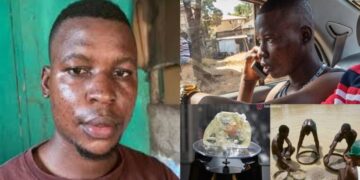
































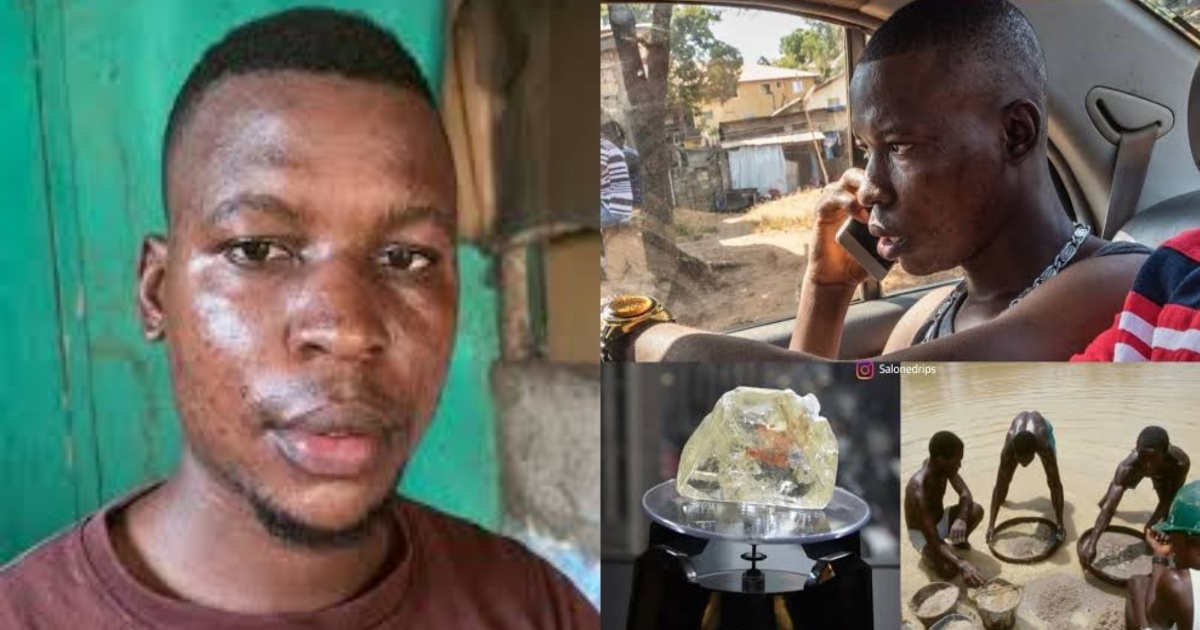
KOYARDU, KONO DISTRICT — He was just 16 years old, digging in the gravel like hundreds of other young boys in Kono.
On March 13, 2017, Komba Johnbull picked up a stone that felt different in his hand. It was big — egg-sized, rough, and heavy. He showed it to an experienced miner, who immediately knew: this was no ordinary stone.
It was a 709-carat diamond.
It was the largest diamond found in Sierra Leone in almost 50 years, and one of the largest ever found in the world. It would later be named the Peace Diamond.
For a brief moment, a teenage artisanal miner from a village with no electricity, no running water, no school and no hospital was holding a fortune in his hands.
A Boy, A Pastor, And A Decision
Johnbull was one of five diggers working under a mining licence held by Pastor Emmanuel Momoh, an evangelical pastor who had supported their work.
In Kono, the story usually ends the same way: a big stone is found, it is smuggled out quietly, and the digger who found it stays poor while the money disappears abroad.
This time was different.
Pastor Momoh refused every offer to smuggle the diamond. Together with Paramount Chief *Paul Ngaba Saquee V*, he took the stone to Freetown and personally handed it to then-President *Dr. Ernest Bai Koroma*, insisting it be sold openly, for the benefit of the people.
It was a deliberate break with Sierra Leone’s history of “blood diamonds” — stones that helped fuel the country’s brutal 11-year civil war, which ended in 2002.
Johnbull, barely out of childhood, had suddenly become part of a national story.
From Koyardu to New York
The Peace Diamond became world-famous.
On May 11, 2017, it was offered at an auction in Freetown. The top bid was $7.08 million. The government rejected it, believing it could do better on the world stage.
Seven months later, on December 4, 2017, the diamond was sold in New York to British billionaire jeweller Laurence Graff for $6,536,360 — actually less than the bid rejected in Freetown.
Graff, who normally only buys top-colour diamonds, was said to have overbid because of the symbolism: a diamond sold transparently, to fund development in the place where it was found.
At the time, officials said the money would go to clean water, electricity, schools, health centres and roads in Koyardu and the wider chiefdom.
What Happened to the Boy Who Found It?
That is where the fairy tale gets complicated.
The plan was for about $3.9 million to go to government in taxes, about $980,454 to a community development fund, and about $1 million to be split among the five diggers and Pastor Momoh.
But later reports suggested the diggers received far less than promised. Johnbull was reportedly left with only about $10,000 after deductions and payments to others, while development projects in Koyardu moved slowly.
For a 16-year-old who had found a stone worth millions, it was a harsh lesson in how diamond wealth has always worked in Sierra Leone — the person who finds it is rarely the person who keeps it.
Why His Story Still Matters
Nearly nine years later, Komba Johnbull’s name is still remembered in Kono and across Sierra Leone.
Not because he became rich. But because for one moment, a teenage miner held in his hands proof that Sierra Leone’s ground still holds extraordinary wealth — and a question that still hangs over the country:
If a 16-year-old can find $6.5 million in the gravel, why do the villages where diamonds are found still have no water, no light, and no school?
That is the question the Peace Diamond was supposed to answer.