







































BY: Andrew Keili
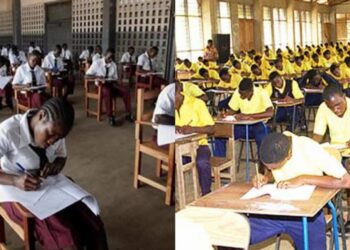
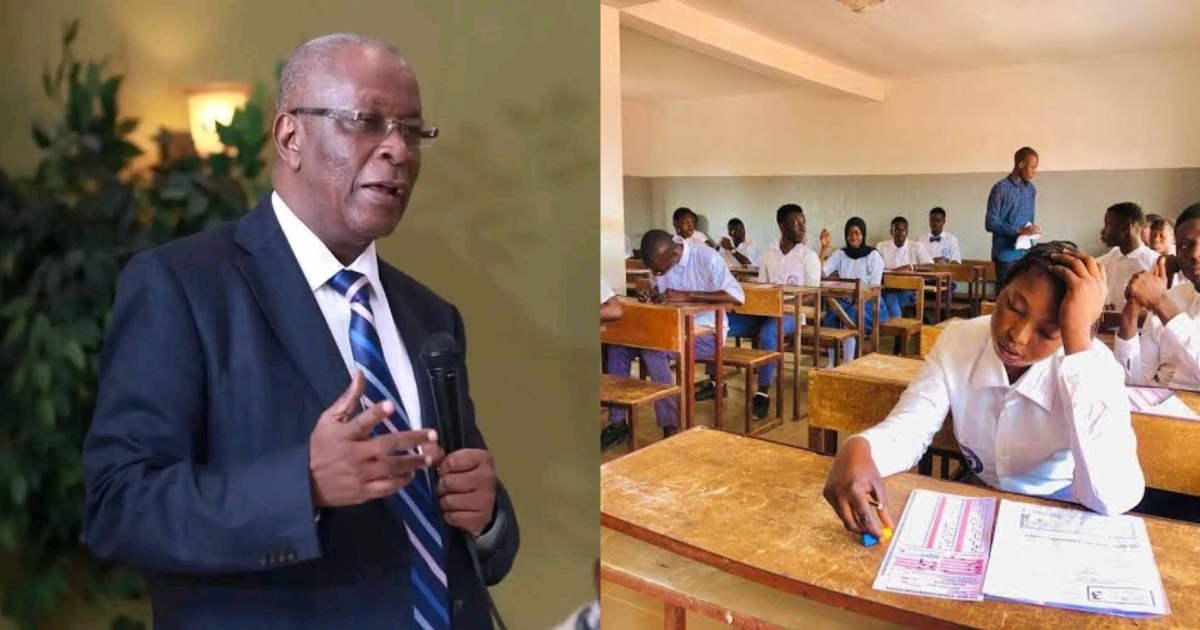
Sometimes malapropism is not such a bad thing. The chap who referred to Sierra Leone as the “Anthem of West Africa” was probably onto something. He must have been thinking about the collective chorus of wailing that has accompanied our mass failure in the WASSCE English language examinations. In the 2026 WASSCE results, a staggering 63.33% of candidates failed English outright, with less than 10% (a dismal 9.7%) achieving a credit pass (A1–C6). Comparatively, our neighbours in Ghana recorded a robust 62.4% pass rate in the same category. While the Sierra Leone English pass rate has been stubbornly hovering around the 10% mark over the past four years, Ghana’s average has coasted at a substantially higher 68.5%. The real paradox? Despite our linguistic woes, Sierra Leone actually recorded a massive 81.4% overall subject paper pass rate in 2026, alongside a strong 62.15% pass rate in Mathematics. We can calculate the hypotenuse of a triangle, but we just cannot describe it in a coherent sentence.
One cannot dispute the massive fall in standards within written and spoken English in Sierra Leonean society. I cannot help but chuckle—and shudder—at some of my own encounters. We are no longer in the era of the infamous Miss Port Loko, who, when asked, “Miss Port Loko, can you speak English?” confidently replied, “No, no, no, ka Themne gbet!”
Lately, the blunders are closer to home. I once interviewed a university graduate who came to my office seeking an internship. When she earnestly revealed that she was there for an “in township,” I was forced to politely inform her that the vacancy in that particular municipality had already been filled. On another occasion, I was part of a panel examining engineering graduates. Noting an erratic chart, I told the hapless student that his graph looked a bit dodgy. “Where did you get your figures from? You must have plucked them from the air,” I remarked. He smiled warmly and answered, “Yes, Sir!”—completely oblivious to the fact that I had just accused him of scientific sorcery.
This poor English syndrome has even infected our journalism. I still recall the classic newspaper report where the journalist solemnly wrote that a prominent citizen went up to Fourah Bay College (FBC) to personally receive his “posthumous” award. One can only imagine the standing ovation from the afterlife.
But the mass failure in English is ultimately no laughing matter, and the statistics are certainly not plucked from thin air. A vast pool of qualified students is now completely locked out of higher education. Why the absolute fuss about the English language? Because English serves as our primary medium of instruction, academic research, and institutional evaluation. A student must be able to digest complex textbooks, write coherent research papers, and follow fast-paced lectures. Employers, too, expect employees who can express themselves clearly, think logically, and write reports that do not require a cryptographer to decode.
The failure in English has created a bizarre crisis: a massive pool of students who excel in STEM but are completely barred from universities. It seems entirely contradictory that a student can successfully clear complex formulas in Chemistry, navigate the structures of Government, or solve advanced Mathematics, yet repeatedly fail English. But the explanation is simple. Students think, socialize, and express emotions in their native mother tongues. Subjects like History, Biology, or even certain mathematical formulas can be conquered through brute-force memorization and intense cramming. English, however, demands active comprehension, structural logic, and essay-writing skills that cannot be memorized overnight. As someone recently remarked to me with a wry smile, “It is also remarkably difficult to ‘spy’ or copy your neighbour’s answers in an English essay paper!”
This raises a vital question: Is it truly in our national interest, or even fair, for universities to reject a student with an A1 in Further Math and a C5 in Chemistry just because they landed an F9 in English? Are we protecting academic integrity, or are we just cutting off our nose to spite our face? We can learn a lot from how other countries navigate this hurdle.
South African universities accept diverse National Senior Certificate scores, sensibly matching the language requirement to the student’s specific major rather than using English as a blanket executioner for STEM applicants. Institutions like the University of Cape Town (UCT) and the University of the Witwatersrand (Wits) pioneered Extended Curriculum Programmes (ECPs). These programs explicitly admit students from disadvantaged schools who missed standard language thresholds but showed high aptitude in Math and Science. Tracked over a decade, these ECP students graduated at equal, and sometimes higher, rates than those who entered through the traditional, rigid direct-entry route. Once provided with a dedicated first year combining foundational academic literacy with core science modules, their baseline intelligence easily overtook the language deficit.
Look at Rwanda. In 2008, the country abruptly shifted its entire education system from French to English. Instead of panicking, they launched the School-based Mentorship Programme. Rather than hosting occasional, useless workshops, the Rwandan Ministry of Education embedded full-time English mentors directly into schools to co-teach and upskill educators in real-time. They also embedded debate clubs and dramatic societies into the formal curriculum. The government faced a choice: stop training engineers until they learned perfect English, or train them in engineering while fixing their English. They chose the latter, heavily injecting language support into technical colleges. This cohort—many of whom spoke barely any English when entering tertiary institutions—went on to build Rwanda’s current tech-driven economy. They didn’t need to write Shakespearean prose to code software, manage national drone delivery networks, or build infrastructure.
Closer to home, universities in Nigeria (regulated by JAMB) and Ghana utilize Pre-degree and Remedial Pathway Programs. In Nigeria, the Interim Joint Matriculation Board (IJMB) and university-run remedial tracks have bypassed the rigid WASSCE English blockade for decades. Students study their core science subjects alongside intensive, targeted “Use-of-English” courses for 9 to 12 months. Studies across Nigerian federal universities consistently show that these remedial-entry students frequently outperform direct-entry students in their later years. Because the remedial year teaches actual academic reading and critical thinking—rather than just how to pass a high-school grammar test—it sets them up for superior university research.
The recent steps taken by the University of Makeni (UniMak) to grant provisional admission to students on the condition that they clear their English requirements before graduation, alongside the University of Sierra Leone’s easing of entrance conditionalities for certain courses, are highly welcome initiatives. This should be standard practice. Rather than blocking brilliant minds, all our universities should introduce structured Provisional Admissions & Remedial Programs. Let them enter, and put them through mandatory, intensive academic English foundational courses during their first year to catch up.
To be fair, the Education Ministries have not been sitting idly by. Sierra Leone has been wrestling with a deep-seated, foundational literacy crisis that tracks with students all the way into their senior secondary years. The MBSSE has instituted strict new entry criteria for students transitioning into senior secondary school (SSS). The Partnership Compact explicitly targets a complete overhaul of reading pedagogy in grades 1 through 4, and the Teaching Service Commission (TSC) has rolled out specialized, phonics-based teacher training modules for primary educators. The Ministry has mass-produced and distributed specialized English Lesson Plans and scaled up tablet-based Digital Foundational Learning interventions to accelerate reading proficiency. Emergency in-service training programs specifically for English teachers will also greatly help to ameliorate this problem.
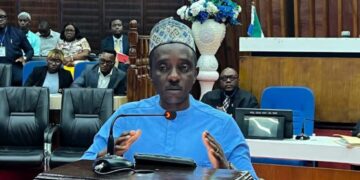
But this crisis is too pervasive to be left to the Ministry alone. The reactionary “Sack Sackey” campaigns aimed at the Minister of Basic and Senior Secondary Education, Conrad Sackey, championed by some detractors will not solve structural issues. It is refreshing to hear honest, transparent answers from the Minister on these thorny educational issues instead of watching them get swept under the rug. All stakeholders must put their hands on deck—from parents and community leaders to teachers and WAEC. Community interventions like enforcing school attendance, cultivating a genuine reading culture at home, and curbing administrative lapses will do wonders. We must imbibe a reading culture. Parents encouraging their children to swap one hour of screen/television time for a book would do them a work of good.
We must also collectively depoliticize our education data. Policy should focus strictly on raw metrics rather than political messaging, allowing the country to face the true depth of our literacy crisis with transparent honesty.
Let’s return to the crux of the university admission problem. The various alternative pathways being proposed must become permanently funded, structured national policies rather than temporary, desperate compromises. When universities open their doors to students who failed English but excelled in their core fields, the long-term results worldwide are overwhelmingly positive. When an institution rejects a student with an A1 in Further Math and a C5 in Chemistry just because of an F9 in English, that university isn’t protecting academic integrity—it is actively participating in national economic sabotage.
We must stop punishing the symptom. Mass failure is an indictment of the educational system, not the intellect of the student. Other nations treat English as a functional tool and a medium of instruction. In Sierra Leone, it is too often weaponized as an elitist gatekeeper.
It is time to stop singing that tired, old “anthem” that brands our youth as failures. Let us instead tackle our English language problem practically, sustainably, and inclusively.
Ponder my thoughts.