






























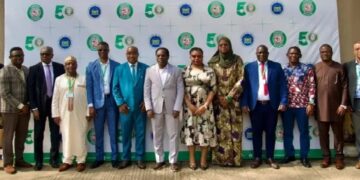





















Lungi, Sierra Leone — 16 April 2026 — Sierra Leone’s President Julius Maada Bio on Thursday inspected Pee Cee Agriculture Limited’s expansive onion farm and state-of-the-art processing facility in Mathene Village, Lokomasama Chiefdom, Port Loko District, reaffirming the government’s strong commitment to transforming agriculture and achieving national food security through the Feed Salone initiative.
The visit underscored the project’s impressive growth since its early days as a pilot. What began as a modest operation has rapidly scaled into one of Sierra Leone’s largest commercial farming ventures. Supported by a US$12 million investment from the International Finance Corporation (IFC), the fully irrigated and mechanized farm spans up to 500 hectares and aims to produce over 40,000 tons of onions annually, alongside maize and other staples. Modern storage infrastructure and a new processing facility are enhancing value addition, extending shelf life, and improving year-round market supply.
President Bio praised the private sector-led model, describing Pee Cee Agriculture, formerly the country’s largest onion importer, as a shining example of how local investment can drive agricultural transformation, create jobs, and reduce heavy reliance on food imports.
He noted that Feed Salone, the flagship program under the Medium-Term National Development Plan (2024–2030), is gaining strong momentum nationwide, with rising participation from investors helping to boost productivity, rural livelihoods, and resilience against climate and external shocks.
In a significant step toward gender inclusion, the President announced an additional 30 percent allocation for women’s participation in the project, aligning with Feed Salone’s pillar on empowering women and youth in agriculture.
Officials highlighted substantial expansion in cultivated area, improved irrigation systems, higher yields, and increased employment opportunities for local communities, including training for young farmers. The initiative has already contributed to a notable decline in onion imports and falling market prices for staples.
The visit ended with a guided tour of the fields and processing house. Stakeholders expressed optimism that such public-private partnerships will advance sustainable agriculture, generate thousands of jobs, and move Sierra Leone closer to long-term food self-sufficiency by reducing dependence on imported onions, rice, and other essentials.