































































By Hon. Abdul Kargbo
Minority Leader
Parliament of Sierra Leone
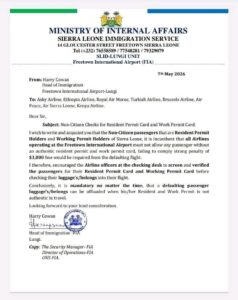
I have carefully read this notice issued by the Head of Immigration at the Freetown International Airport, and while the intention may be to address concerns relating to forged resident and work permits, the document raises serious legal, administrative, and operational concerns that cannot be ignored.
First, the notice attempts to transfer the responsibility of verifying the authenticity of resident permits and work permits from Immigration authorities to private airline staff. Airlines are not immigration institutions, neither are their officers trained or legally empowered to authenticate Sierra Leone immigration documents. The responsibility for verifying immigration status rests primarily with the State through its Immigration Department.
Secondly, the notice threatens airlines with a US$3,000 penalty for non-compliance, yet nowhere in the document is any law, statutory instrument, regulation, or policy cited to justify such a fine. Administrative notices cannot simply create penalties without a clear legal basis. This raises serious questions about the legality and enforceability of the directive.
Another concern is the authority under which this notice was issued. The signatory is the Head of Immigration at the Lungi International Airport. One must ask whether an airport-based immigration head possesses the legal authority to issue binding directives to multiple international airlines operating in Sierra Leone. A directive of this magnitude should ordinarily emanate from the Chief Immigration Officer, the Ministry Headquarters, or through a formally gazetted regulation.
The document is also poorly drafted and contains several grammatical and professional errors that undermine its credibility. Official communication directed to international airlines should meet a high standard of clarity, professionalism, and legal precision. Unfortunately, this notice falls short of that standard.
Operationally, the directive creates confusion. It states that luggage can be offloaded “no matter the time” if permits are found not to be authentic. However, it does not explain:
how authenticity is to be verified,
what system airlines should use,
which office should confirm authenticity,
what happens when systems are unavailable,
or who bears responsibility if a passenger is wrongly denied boarding.
The notice also appears inconsistent with standard international aviation practice. Airlines already conduct passport and visa checks in line with destination requirements. Asking airline staff to authenticate domestic residency and work permits goes far beyond normal airline obligations.
Equally troubling is the absence of any verification mechanism. There is no hotline, verification portal, contact office, or digital system provided to airlines to enable them comply with the directive. Compliance therefore becomes practically difficult and vulnerable to arbitrary decisions.
Lastly, the overall presentation of the notice reflects weak administrative procedure. There is no reference number, no legal citation, no proper policy framework, and the formatting itself lacks the standard expected of an official international compliance directive.
As a country, we must certainly strengthen our immigration systems and tackle document fraud. However, such actions must be lawful, professionally communicated, operationally practical, and institutionally sound. Poorly drafted directives that exceed legal authority only create confusion, expose the country to embarrassment, and undermine confidence in our institutions.