































































Freetown – Long-serving employees across Sierra Leone stand to lose more than half their statutory end-of-service pay if the Finance Bill 2027 becomes law. The government published the Bill in the Gazette on 17 November 2026. It is scheduled to take effect on 1 January 2027.
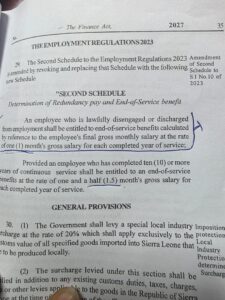
The Bill rewrites the Second Schedule of the Employment Regulations 2023. That table currently sets the minimum end-of-service benefit and redundancy pay for workers nationwide. Sources say the proposed change has already triggered a wave of resignations at the Bank of Sierra Leone, as staff rush to claim benefits under the existing rules.
AYV News carried unconfirmed reports of the departures on 25 November. The Bank has not confirmed the figures. A source who spoke on condition of anonymity told this newspaper that more than 70 staff have left the central bank in recent weeks.
The Bill also doubles the personal income-tax threshold, requires a tax clearance certificate for every bank account, introduces a NLe10 annual poll tax, and places a 20 percent surcharge on imports that compete with local goods.
How the end-of-service formula changes
Under the present Schedule, workers receive between 6 and 18 weeks’ pay according to length of service. Anyone with more than 15 years’ continuous service is entitled to 18 weeks. The wording does not clearly state whether these weeks form a single total or a rate for each year worked.
If read as a rate per year, a worker with more than 15 years’ service currently receives the equivalent of about 4.15 months’ salary for every year completed. Some banks and mining companies have told the Labour Ministry that these rates are becoming difficult to sustain.
The new Bill replaces the table with a simple formula: one month’s final gross salary for each completed year of service, rising to one-and-a-half months once the worker reaches ten years of continuous service.
Calculations treating the current Schedule as weeks of pay for each year of service show the scale of the reduction. A worker with three years’ service would move from roughly 4.2 months’ pay to three months. At ten years the payment would fall from about 23 months to 15 months. At 14 years it would drop from about 45 months to 21 months. A worker with 20 years’ service would receive about 30 months’ salary instead of roughly 83 months – a cut of around 64 percent.
If the present Schedule is read strictly as a single total of weeks rather than a per-year rate, the same long-serving worker now receives only 18 weeks, and the Bill would actually increase the payment to 30 months.
The Bill contains no transitional or saving clause. The new rate would apply to every year already served, including years before 2027. Because the Employment Act 2023 grants the end-of-service benefit on resignation, any worker whose employment ends before 1 January 2027 keeps the current entitlement.
The revised Schedule also removes the words “minimum standards” and the exemption for workers covered by collective agreements. The Employment Act itself still allows employers to offer more generous terms.
Tax clearance now required for every bank account
Banks, microfinance institutions and other financial-service providers licensed by the Bank of Sierra Leone will be barred from opening, maintaining or operating any account – personal, business, partnership or NGO – without a Taxpayer Identification Number (TIN) and a valid Tax Clearance Certificate.
Existing customers will have 90 days from the commencement date to supply a TIN. Banks must report all new accounts and TINs to the National Revenue Authority every quarter. Breaches attract penalties under the Income Tax Act 2000. Taken literally, every salary earner, trader and student with a bank account will need a tax clearance certificate.
Relief for lower-income earners
The Bill raises the annual tax-free threshold to NLe14,400 (NLe1,200 a month). Income above that level is taxed at 15 percent up to NLe24,000, 20 percent up to NLe33,600, 25 percent up to NLe43,200, and 30 percent thereafter.
Current guidance based on National Revenue Authority figures puts the tax-free amount at NLe600 a month, with the top rate starting above NLe2,400 a month. The Bill therefore doubles the threshold and pushes the 30 percent band to income above NLe3,600 a month. A separate clause limits tax-free employee allowances to NLe12,000 a year.
New levies and charges
A 20 percent local-industry protection surcharge will be levied on the customs value of imported goods appearing on a list published in the Gazette by the Ministers of Finance and Trade. The surcharge is additional to all existing duties and taxes. Evasion carries a minimum fine of NLe50,000 or three times the surcharge for individuals (whichever is higher) and up to three years’ imprisonment. Companies face a minimum of NLe250,000 or five times the surcharge, and the goods are forfeited.
Every ordinary resident aged 18 and over must pay an annual Poll Tax of NLe10 to the local council. The tax is due on 1 January and must be paid by 30 April. Certified indigents, full-time students and persons with severe physical or mental disabilities are exempt.
The petroleum-fund levy doubles from NLe0.40 to NLe0.80 per litre, with the full amount retained by the National Petroleum Regulatory Authority.
Online sellers must register with the National Revenue Authority, obtain a Digital Merchant Code, and channel all electronic and mobile-money receipts through that code. Receiving sales proceeds in a personal wallet or bank account becomes an offence. Payment providers may not onboard sellers who lack a TIN and a verified code.
Customs, exemptions and business rules
Holders of duty exemptions must submit a six-month import plan before each period or risk suspension. Goods on a gazetted list of locally produced items lose exemption status altogether. Every exempt consignment must clear through the Sierra Leone National Shipping Company Limited or its designated agents.
Mining, construction, agricultural and manufacturing companies retain exemptions only for items linked to their core operations. Diplomatic missions and recognised international organisations remain outside the new rules.
Clearing and forwarding agents will need a US$25,000 bank guarantee, at least five dedicated staff, police clearance and residence in Sierra Leone to hold a licence. Petroleum importers must pay all duties in full at the point of entry.
Bidders for public contracts above the national competitive threshold must present a QR-verifiable Certificate of Good Standing from the National Investment Board or face automatic rejection. The Commissioner-General of the National Revenue Authority will require the Minister’s written approval before signing any Advance Pricing Agreement.
Foreign firms face a wider tax net. The Bill taxes offshore sales of shares in entities that derive more than half their value from Sierra Leone property or mineral rights, and treats digital services used in Sierra Leone as local income.
Higher fees across government
The First Schedule raises fees at many government agencies. Registering a private company at the National Investment Board rises from NLe250 to NLe4,000. Filing annual returns moves from NLe50 to between NLe1,200 and NLe3,500, depending on company size and filing method.
Naturalisation fees are now denominated in US dollars, ranging from US$1,500 for ECOWAS nationals to US$15,000 for non-African foreign nationals and US$32,000 for naturalisation by investment.
The annual fee for domestic charcoal production rises from NLe200 to NLe5,000, reflecting concerns over deforestation. The Schedule also introduces new timber export taxes, updated state land values for the Western Area, planning-permit fees and civil-registration charges.
What happens next
The Bill now goes before Parliament. On 24 November, one week after the Gazette publication, the Ministry of Employment, Labour and Social Security opened a tripartite review of the same Second Schedule with employers and the Sierra Leone Labour Congress.
Labour Minister Umaru Napoleon Koroma told the meeting the Ministry would abide by the common position reached by employers and workers. Max Conteh of the Labour Congress said the Congress is not opposed to a review, but warned against any change that weakens the protections workers currently enjoy.
Two simple amendments could ease pressure on long-serving staff: a saving clause that preserves the current rate for service up to 31 December 2026, and clearer wording confirming that the Bill’s rate is a minimum rather than a ceiling.