




























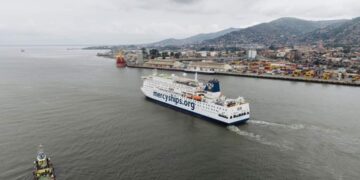



























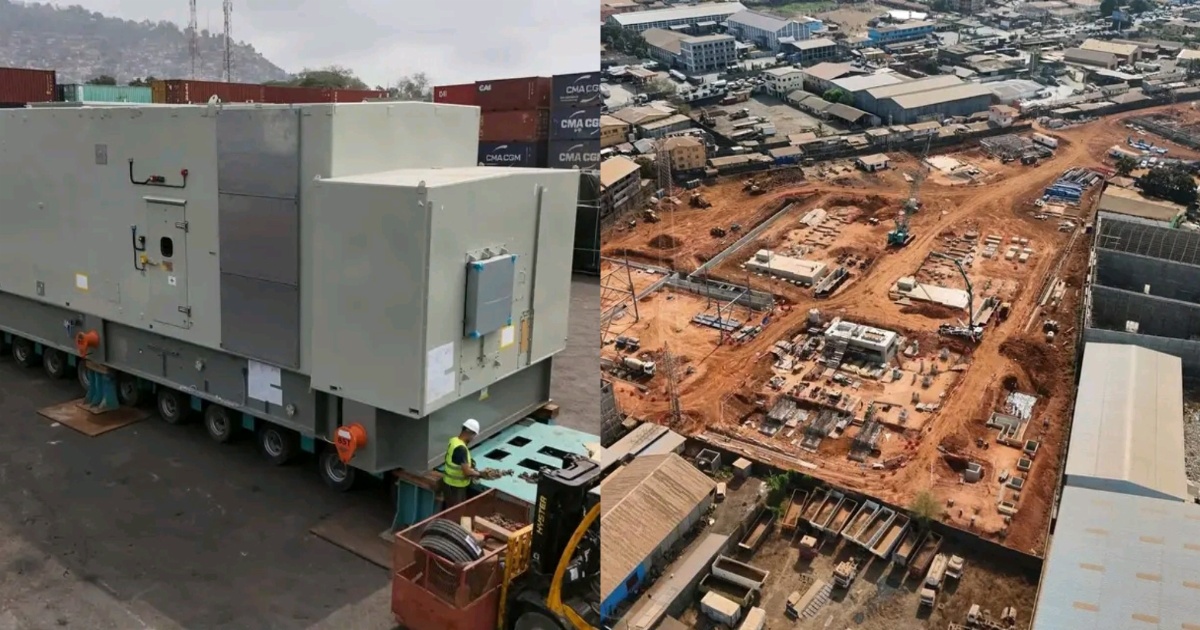
Freetown, Sierra Leone – April 2026 — A major milestone in Sierra Leone’s push for energy security has arrived: the first turbine and generator for the Nant Power Project docked in Freetown this week, marking tangible progress on the country’s first large-scale independent power producer (IPP) plant.
The equipment, transported by vessel, will be installed at the Kissy Terminal (also known as Kissy Dockyard or Fuel Terminal) in eastern Freetown, where a 108.4 MW (often cited as approximately 105–108 MW) combined-cycle gas turbine (CCGT) thermal power plant is under construction. Once fully operational, the facility is expected to nearly double Sierra Leone’s current electricity generation capacity and deliver reliable baseload power to the national grid.
Project Background and Financing
The Nant Power Project (also referred to as the Nant Energy Project or CECA SL Generation Limited) reached financial close in November 2024. It is backed by a robust financing package totaling around $417 million, one of the largest private infrastructure investments in Sierra Leone’s history, equivalent to roughly 5% of the country’s GDP:
– $292 million in senior debt from the U.S. International Development Finance Corporation (DFC).
– $40 million from the ECOWAS Bank for Investment and Development (EBID).
– $85 million in equity from sponsors TCQ Power and Anergi Group.
The project also benefits from DFC political risk insurance and a pioneering liquidity reserve structure to address payment timing challenges common in frontier markets. Construction is being executed by Shapoorji Pallonji using Siemens CCGT technology. The plant is designed as a multi-fuel facility, initially running on liquefied petroleum gas (LPG) or diesel, with plans to transition to imported LNG once a dedicated U.S.-sourced LNG terminal is developed in Sierra Leone.
Expected Impact
Developers and government officials describe the plant as a game-changer. Abu Kamara, General Manager of the Nant Power Project, stated that the facility will “strengthen national energy security and promote economic growth by providing more reliable power.” It is expected to supply approximately 60% of Freetown’s electricity demand and support broader ambitions for 24-hour power supply across the country, reducing reliance on costly emergency diesel generation and enabling light industry and productive uses of electricity.
The plant will operate under a 22-year Power Purchase Agreement (PPA) with the Government of Sierra Leone and the Electricity Distribution and Supply Authority (EDSA).
Timeline and Context
Project developers report that construction is advancing on schedule, with first power anticipated in the third quarter of 2027 (with some earlier interim targets mentioned in related updates). The arrival of the initial turbine and generator represents a concrete step toward that goal.
Sierra Leone’s current installed electricity generation capacity stands at roughly 250–270 MW (with lower effective/functional capacity), and only about 30–36% of the population has access to electricity. The Nant project is viewed as a foundational step toward long-term targets, including 80% national access by 2030 and significantly higher overall capacity.
Chief Minister David Moinina Sengeh and the Ministry of Energy have highlighted the delivery as the start of a new phase in the country’s power sector, describing it as a “first of its kind in the region.”
This development comes amid ongoing efforts to modernize the grid, expand transmission and distribution, and integrate more renewables, while addressing chronic power shortages that have long hampered economic growth and daily life in Sierra Leone.