



















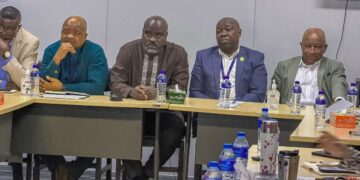



















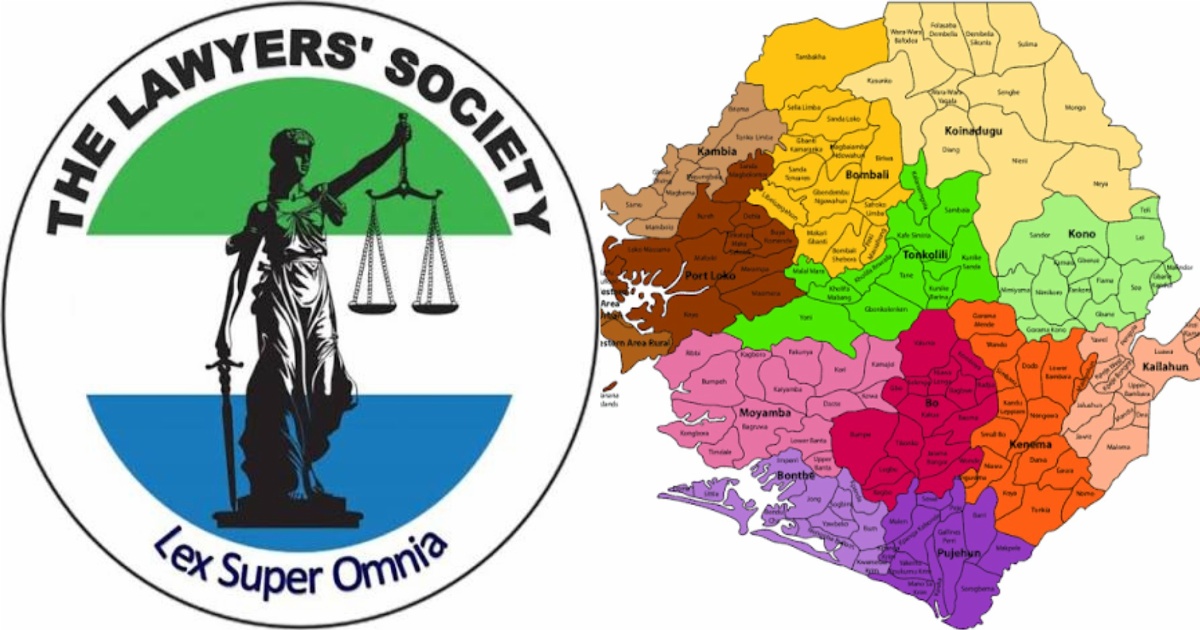
FREETOWN, 1 October, 2026 – The Lawyers’ Society of Sierra Leone has asked Government to withdraw a set of statutory instruments that seek to split Freetown into two cities, grant city status to Lungi, and create new districts and chiefdoms across the country.
In a press statement issued on Wednesday, 1st October, the Society said Government Notices No. 246 to 277, published in the Extraordinary Gazette of 16th September 2026 and which came into wide public circulation on 30th September, were gazetted without proper consultation and without going through the laid-down parliamentary process.
The Society singled out three orders for urgent action – Statutory Instrument No. 13 of 2026 which seeks to establish Freetown City Council, No. 15 which seeks to create Freetown West City Council, and No. 19 which seeks to establish Lungi City Council.
It is urging Government to halt all steps to implement the new map, and calling on Parliament to reject the three instruments until the law is fully complied with.
What Is In The Gazette?
The Gazette, Vol. CLXVII No. 77, contains Statutory Instruments No. 5 to 33 of 2026.
If enforced, the orders will increase the number of districts from 16 to 18. The two new districts are Bandajuma District – carved from parts of Bo and Pujehun Districts – and Kpanguima District, also referred to as Kpanguma, carved from Kenema and Kailahun.
In the Western Area, the instruments propose five councils to replace the current two – Freetown City Council, Freetown West City Council, Lungi City Council, Mountain Rural Council, Waterloo Rural Council and York Rural Council. The package also creates new chiefdoms and village chiefdoms.
Legal experts note that while gazetting gives the new entities legal names, it does not by itself create offices, staff them, draw physical boundaries on the ground, or fix a date for local council elections.
Government Position
The proposals were first approved in principle by Cabinet on 27th May 2025.
The Minister of Local Government and Community Affairs, Tamba Lamina, has defended the plan as part of the second phase of decentralisation under the Local Government Act of 2022. The Act gives the President powers to declare new localities by statutory instrument on the recommendation of the Minister of Local Government, the Minister of Finance and the Electoral Commissioner.
Government argues that the 2004 local government map no longer reflects the reality. It says Freetown’s population has more than tripled, the Western Area Rural District has become too large to manage as one unit, and Lungi – home to the Freetown International Airport – needs city status to drive its development as a Gateway City.
Why The Lawyers’ Society Objects
The Society said it is not questioning the President’s power under Section 2(2)(a) of the Local Government Act 2022, but the procedure used.
It cited Section 170(7) of the 1991 Constitution and Sections 3(1) and (2) of the Constitutional and Statutory Instruments Act of 1999, which require all statutory instruments to be laid before Parliament for 21 days before they come into effect. Under Parliament’s Standing Order 18(2), a memorandum showing evidence of stakeholder consultation must accompany the instrument.
The Society argued that meaningful consultation did not happen. It described a Government meeting held on 18th September 2025 at the Freetown City Council Hall as a presentation rather than a consultation, noting that attendees reportedly chanted “No division” during the session.
It contrasted that with a town-hall meeting convened by the Freetown City Council on 26th June 2025, attended by over 600 residents including market women, okada riders, youth groups and civil society, which in Resolution FCC/2026/04 overwhelmingly rejected the plan to divide the capital. The Krio Descendants Yunion has also publicly opposed the split.
The lawyers also raised the issue of timing. They warned that creating new districts more than a year before the national census scheduled for December 2026 goes against Section 38 of the Constitution, which links constituency and ward boundaries to census data. They recalled that Falaba and Karene Districts, created in 2017, came after the 2015 census.
Cost And Governance Concerns
Beyond the legal process, the Society said splitting Freetown would weaken the capital and create councils with unequal financial strength.
It pointed to three main risks – duplication of administrative costs at a time when Government is behind on grants to existing councils; fragmentation of city-wide services like waste management, roads and physical planning; and the risk of gerrymandering.
Sierra Leone currently struggles to fund 22 local councils. Each new council will require a chairperson, chief administrator, staff, offices and vehicles, putting additional pressure on the Consolidated Fund.
The instruments are now in the public domain. The next step will be whether Government lays them before Parliament with the required consultation report, withdraws them as demanded by the Lawyers’ Society, or faces a legal challenge in court.
This would be the biggest redrawing of Sierra Leone’s local government map since 2017.