






























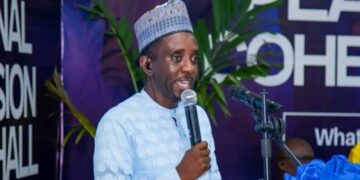



Sierra Leone’s President Julius Maada Bio has told West African leaders that unity within the sub-region is no longer a matter of choice but a necessity for peace, security and shared prosperity.
Addressing the opening of the 68th Ordinary Session of the ECOWAS Authority of Heads of State and Government in Abuja on Sunday, President Bio, who also chairs the regional bloc, warned that instability in any single member state now poses a direct threat to the entire community.
He described the summit as taking place at a critical point in ECOWAS’ 50-year history, urging leaders to recommit themselves to the founding principles of solidarity, cooperation and collective progress.
President Bio said West Africa is currently facing some of its most serious challenges, including terrorism, violent extremism, organised crime and unconstitutional changes of government, with the Sahel remaining particularly vulnerable.
According to him, no country can shield itself from the spillover effects of insecurity. He condemned recent attempts to undermine constitutional order in Guinea-Bissau and Benin, describing such actions as direct attacks on regional stability.
He commended ECOWAS for its swift response to the situations and praised Nigeria for its leadership in coordinating political and security efforts to defend democratic governance. He stressed that the bloc would not compromise on democracy.
President Bio also noted that security efforts must extend beyond military responses to address deeper issues such as poor governance, social exclusion and economic hardship.
He outlined plans to strengthen intelligence sharing, improve joint border operations and secure sustainable financing for regional counter-terrorism initiatives.
On economic integration, he said deeper cooperation was vital to confronting rising living costs, limited job opportunities and external economic shocks.
He reaffirmed commitments to trade liberalisation, monetary convergence and accelerated cross-border infrastructure, emphasising that regional integration must translate into real benefits for citizens.
“Our people expect decisive leadership,” President Bio said, urging leaders to be remembered for strengthening unity and improving lives rather than being overwhelmed by crises.
Representing Nigerian President Bola Ahmed Tinubu, Vice President Kashim Shettima echoed the call for unity, describing West Africa as a family bound by shared history, culture and struggle.
He warned that internal divisions posed a greater danger than external threats, noting that challenges such as violent extremism, arms trafficking, cyber insecurity, climate change, food insecurity and irregular migration do not respect national borders.
Vice President Shettima stressed that no country, regardless of size or influence, could achieve lasting stability in isolation, adding that regional unity is foundational, not transactional.
Meanwhile, President of the ECOWAS Commission, Omar Alieu Touray, said the Authority of Heads of State and Government remains central to the bloc’s peace, integration and development efforts.
He praised regional leaders for maintaining regular consultations over the past five decades and said recent political developments in Guinea-Bissau and Benin had demonstrated the practical value of regional solidarity.
Touray also disclosed that ECOWAS is intensifying efforts to revive economic integration under its Vision 2050 agenda, amid growing global geopolitical tensions and security challenges.
He announced plans to accelerate the operationalisation of the ECOWAS Business Council to mobilise regional capital and promote intra-regional investment, stressing the need to prioritise local private sector participation in driving trade and development across West Africa.