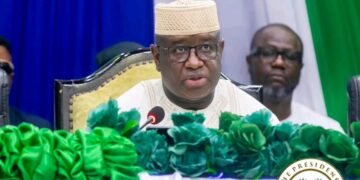







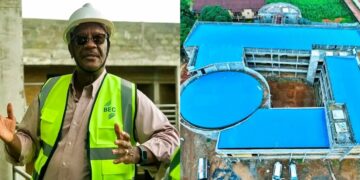





























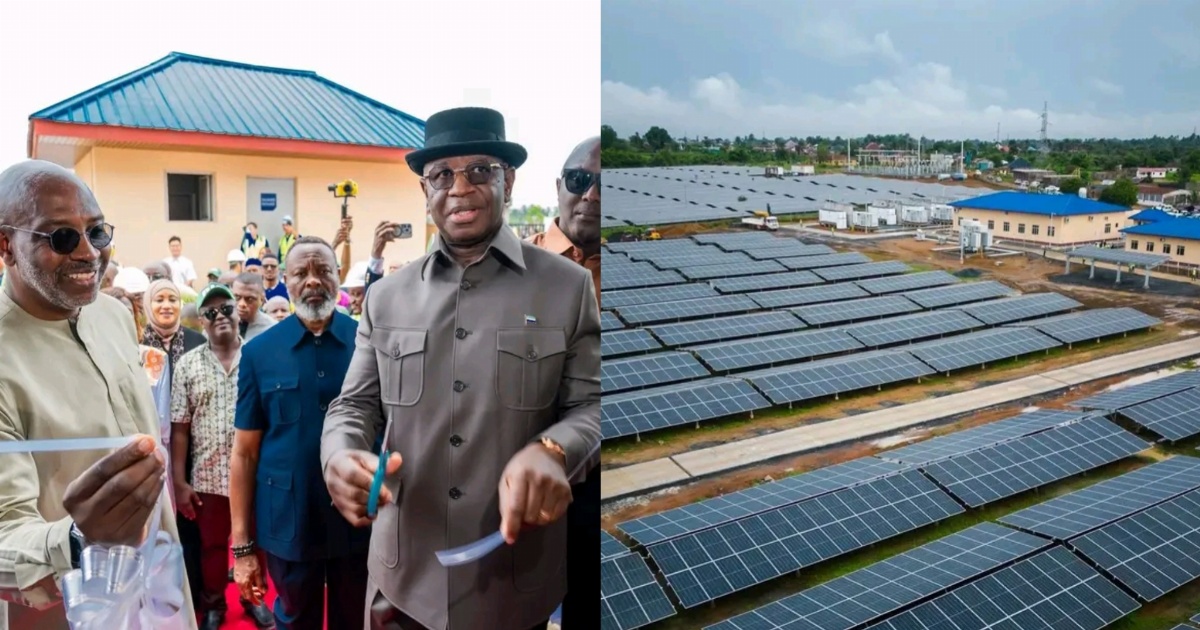
Sierra Leone’s President Dr. Julius Maada Bio has commissioned a 30-megawatt solar power plant with a 15-megawatt-hour Battery Energy Storage System (BESS) in Newton and a 10-megawatt solar power plant with a 6-megawatt-hour Battery Energy Storage System in Lungi.
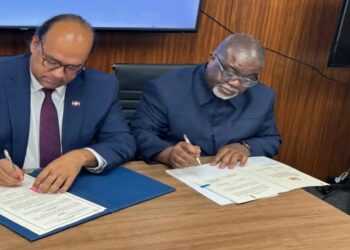
The facilities were developed under the Regional Emergency Solar Power Intervention (RESPITE) Project, supported by the World Bank.
The President described the initiative as “the largest single addition to renewable energy generation capacity in Sierra Leone’s history” and affirmed that the Newton and Lungi Solar Power Projects represent another decisive step in the country’s journey towards energy security, economic transformation, and sustainable development.
Describing the occasion as a defining moment in the nation’s development journey, President Bio said the commissioning reflects not only where Sierra Leone stands today but also where it is determined to go.
The President expressed profound appreciation to the World Bank Group for its unwavering support, technical expertise, and partnership in bringing the RESPITE Project to fruition.
“This ceremony is a statement of Sierra Leone’s ambition. It is a declaration that we are investing in our future. It is proof that when vision is matched by determination, partnership, and action, transformation becomes possible,” he stated.
Drawing from his personal experiences travelling across the country, President Bio spoke of the realities faced by many Sierra Leoneans due to unreliable electricity supply.
“These realities reinforce a simple truth: electricity is not a luxury; it is a necessity,” he said.
The President acknowledged that energy poverty has constrained the full potential of Sierra Leone’s people and economy for far too long, forcing many communities to adapt to darkness, uncertainty, and inadequate infrastructure.
“This is not the future we accept. Today, Sierra Leone sends a clear message: we are moving forward. We are building an energy future that is cleaner, more reliable, more resilient, and more inclusive,” he declared.
He reiterated that the combined 40-megawatt solar power projects will strengthen the national grid, improve reliability, increase resilience, and expand access to electricity for hundreds of thousands of Sierra Leoneans.
“These projects represent a major milestone in our broader effort to build a modern energy sector capable of supporting the aspirations of our people and the ambitions of our nation,” he said.
The President further stressed that the projects are not only energy infrastructure investments but they are catalysts for national development. He said the projects would create jobs, strengthen healthcare and education services, and stimulate industrial growth.
“The true value of these investments lies not only in the electricity they generate but in the opportunities they create. These are nation-building projects,” he emphasized.
President Bio dedicated the achievement to every student who has studied in darkness, every healthcare worker who has served without reliable electricity, every entrepreneur who has persevered through repeated power outages, and every family that has patiently awaited improved electricity services.
“We are building a future in which reliable electricity is not a privilege for a few, but a service available to all,” he affirmed.
The President also extended an invitation to investors, development partners, international financial institutions, climate finance institutions, technology providers, and innovators around the world to partner with Sierra Leone in accelerating its energy transformation agenda.
“Sierra Leone is open for investment. Sierra Leone is open for partnership,” he declared.
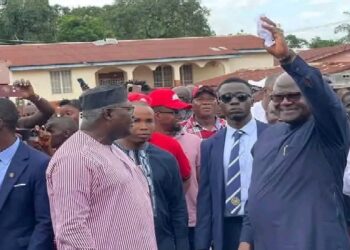
The ceremony also featured statements from the World Bank Country Representative, the Minister of Energy, the Paramount Chief, and other stakeholders, all of whom highlighted the significance of the project in advancing Sierra Leone’s energy sector and supporting national development.