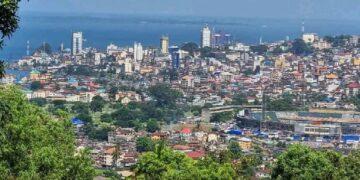






























FREETOWN, 13th October 2026 – The Supreme Court of Sierra Leone resumes today, Tuesday 13th October 2026, the landmark hearing into the controversial Constitution (Amendment) Bill, 2025.
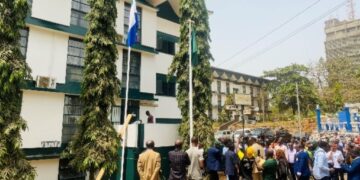
The five-man panel, chaired by Chief Justice Komba Kamanda, is sitting at the Main Law Court Building on Siaka Stevens Street, Freetown.
The Court is hearing three consolidated cases – S.C. 8/2026, 9/2026 and 11/2026 – filed against the Speaker of Parliament, Rt. Hon. Segepoh Solomon Thomas, and the Attorney-General and Minister of Justice, over the passage of the Bill on 10th August 2026.
Because of the hearing, the Judiciary has suspended all High Court sittings at the Main Law Court Building for today. In a notice issued yesterday by Deputy Master and Registrar Mrs. Hulaimatu F. Christian-Moses, the Judiciary said the suspension was necessary because the constitutional matter has taken over the entire building.
What Happened Last Time?
The case was last heard on Thursday 8th October, and it ended in drama.
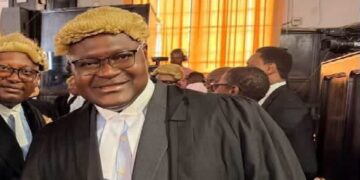
APC lead counsel and former Attorney-General Joseph Fitzgerald Kamara alias JFK was ordered to remove his wig and enter the dock, and was briefly detained for contempt of court after a heated exchange with the bench.
JFK, who is representing APC MPs including Hon. Osman Timbo, Hon. Abdul Kargbo and Hon. Daniel Koroma, had raised a preliminary objection to the participation of the Attorney-General’s office, arguing that the State had not filed its Statement of Case as required by Rule 92(1) of the Supreme Court Rules 1982, and to the consolidation of the cases.
The bench, which includes the Chief Justice, overruled him and allowed the Attorney-General to be heard and also granted an application by the Institute for Legal Research and Advocacy for Justice (IRLAJ) to join as an amicus curiae (friend of the court). The matter was then adjourned to today.
At The Heart Of The Matter: 97 Votes Or 100 Votes?
The substantive legal question is whether Parliament properly passed the Bill.
On 10th August, Speaker Segepoh Thomas ruled that individual clauses of the Bill could be passed under Section 91(1) of the 1991 Constitution, which allows decisions by a simple majority of members present and voting.
After that ruling, APC MPs staged a walkout in protest, leaving only two opposition MPs in the chamber. The Clerk of Parliament then announced that 97 MPs had voted in favour.
Speaker Thomas declared the Bill passed.
But the plaintiffs argue that Section 108(2)(b), which governs constitutional amendments, is clear: any Bill to alter the Constitution must be supported at its second and third readings by “not less than two-thirds of Members of Parliament”. With 149 MPs in total, that means 100 votes, not 97.
They also argue that the Bill was not published as required by Section 108(3), and that some Gazette publications were fraudulent.
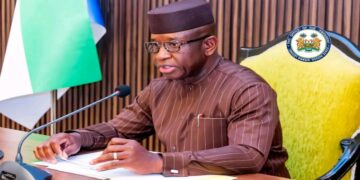
President Julius Maada Bio, after receiving a petition from the Institute for Governance Reform (IGR) on 4th September, did not assent to the Bill but referred it to the Supreme Court under Section 122(1) for interpretation. Speaker Thomas also made his own referral under Section 124.
Why This Bill Matters
The Amendment Bill, 2025 contains major changes ahead of the 2028 general elections:
– Making Proportional Representation (PR) the permanent system for electing MPs, instead of first-past-the-post;
– Reducing the presidential winning threshold from 55% to 50% plus one vote;
– Introducing a 30% minimum quota for women in political party nominations and elective positions.
The opposition APC and several civil society groups say these changes were passed without proper consensus and without meeting the constitutional threshold.
The government side argues that non-entrenched provisions of the Constitution can be amended by simple majority, and that the two-thirds rule only applies to the final passage.
What To Expect Today
Today’s sitting is expected to hear full arguments from the Attorney-General, IRLAJ, and counsel for the APC and Hon. Timbo.
Security is expected to be tight at the Main Law Courts, with heavy presence of lawyers, journalists, civil society activists and party supporters.
The Supreme Court’s eventual ruling will determine whether the Bill is void and whether President Bio can lawfully sign it, and will set a major precedent on how Sierra Leone amends its Constitution in future.