














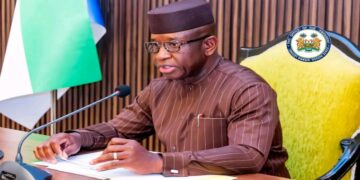
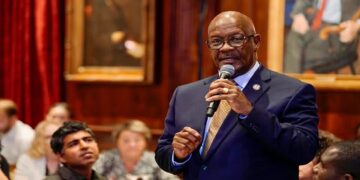





















Freetown, June 4, 2025 — Sierra Leone’s Minister of Environment and Climate Change, Abdulai Jiwoh, has issued a stark warning about the worsening state of the country’s forests and rivers, highlighting the urgent need for stronger environmental protections.
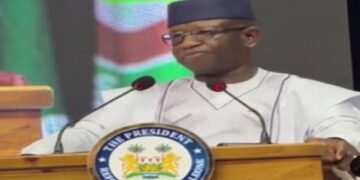
Speaking at the Government Weekly Press Briefing held at Youyi Building in Freetown, Minister Jiwoh emphasized that without decisive action, environmental degradation will continue to threaten the nation’s livelihoods and natural heritage.
He recalled the launch of the Protect Salone for Nature initiative on March 18, describing it as a vital step to halt deforestation and pollution.
“If we do not stop this deforestation and pollution now, there will be serious problems,” he cautioned.
The Minister said the government has since organized a national conference, bringing together Paramount Chiefs, civil society organizations, international partners, and government officials to map out an inclusive implementation plan. “Everyone wanted to be part of the conversation,” he noted.
Implementation teams are now working to incorporate feedback from stakeholders, with both local and international partners collaborating closely to address Sierra Leone’s environmental challenges.
Addressing concerns about encroachment at the Tacugama Chimpanzee Sanctuary, Minister Jiwoh confirmed the severity of the issue after a recent visit.
“The challenges are real, and many of them are caused by us, the citizens,” he acknowledged.
He highlighted the government’s partnership with Tacugama and the National Protected Area Authority (NPAA), which has been deploying guards to protect the sanctuary. Despite these efforts, he said overlapping institutional mandates complicate the situation.
Nevertheless, Jiwoh stressed the government’s unwavering commitment to protecting the Western Area Peninsula National Park, which he described as a critical resource for both biodiversity and human survival.
“We’re not just talking about chimpanzees; we’re talking about our own lives,” he said. “If the park is destroyed and there is no water, how can we live in Freetown?”
To underscore his point, he referenced the Jui–Regent Highway: “On the left side, where the forest was cleared in 2012, water sources have dried up. On the right side, which is still protected, the forest is thriving. That’s the difference. It’s not just a story—it’s a real calamity we face.”
Minister Jiwoh warned those involved in illegal encroachment that their actions jeopardize everyone’s safety.
“People think they’re protected by their connections, but they’re putting all our lives at risk,” he said. “If the chimpanzees leave the sanctuary, who can protect themselves from them?”
He clarified that the government’s environmental efforts are not politically motivated but are driven by the need to protect lives and property. “Citizens also have a duty to act responsibly and safeguard the environment,” he added.
On a related note, the Minister provided updates on the Salone Coastal Resilience Project, noting that climate change is causing unpredictable rainfall and severe coastal erosion in Sierra Leone.
“Our farmers are confused; rains no longer come when expected, and along the coasts, the sea is eating into the land,” he explained.
The project, slated for launch within the next six months, will focus on using nature-based solutions and technology to help vulnerable communities from Kambia to Bonthe adapt to rising sea levels and protect their ecosystems.
“We aim to support hundreds of thousands of people living along our coasts,” Minister Jiwoh stated.
The Minister reaffirmed his commitment to work alongside stakeholders like Tacugama and ensure the protection of the Western Area Peninsula National Park and other natural treasures of Sierra Leone.